

Ode To George
If this is it for peak George Kittle, we may never see his like again.

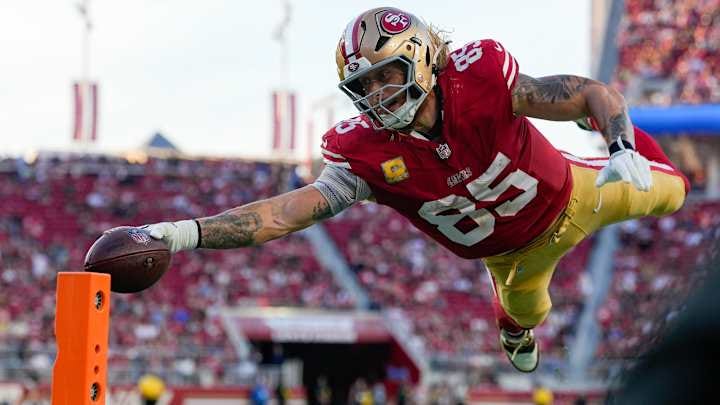
There have been plenty of Tight Ends who are great receivers and can carry their passing games. Those will not go anywhere. There have been plenty of Tight Ends who are an extension of the Offensive Line, bruisers who move Defensive Ends and are the most singularly valuable elements of the run game. Those will not go anywhere. There have been so precious few who are both. That list is tiny, basically just Gronk, Jason Witten, and George Kittle. Others of that type have been productive receivers, like Ben Coates, Dallas Goedert, Tucker Kraft, or Martellus Bennett. Others who can catch the ball at an elite level have been usable in-line blockers, like Tony Gonzalez, Shannon Sharpe, or Antonio Gates. There have again been precious few who are both. Their net value eclipses that of any non-QB on the offensive side of the ball. Those guys are nuclear reactors of offensive production, both direct and indirect. If you think it’s hard to find a Hall of Fame QB, it’s way easier to find one of those than one of these. Every time a unicorn dies, you wonder if you’ll ever see another. Kittle isn’t dead, as he said to Kyle Jusczyck, the Robin to his positionless Batman, in the locker room after his achilles injury, but he’s 32 years old, will likely miss all of next season, and return off an achilles tear at 34. For a guy whose superpowers are based in large part on being so freakishly agile and explosive he shouldn’t exist in his body, that could be a tough path back. Now, medical people online think, especially given his clean tear, that he may be fine, but it’s still a big unknown. He’ll be back, he’ll probably be good, but it’s a strong possibility we’ve seen his time as a unicorn come to an end. Regardless, this is a great opportunity to appreciate what we have.
The Impact
George Kittle, at his peak, is the most valuable non-QB in the NFL on the offensive side of the ball, and arguably overall. I think the loss of him doomed the 49ers this year more than a season-ender to Brock Purdy would have. In my view, it did even more damage than the combined absences of Warner and Bosa. While I’d love to wax poetic, my good friend Scott Barrett of Fantasy Points already did a lot of my work for me
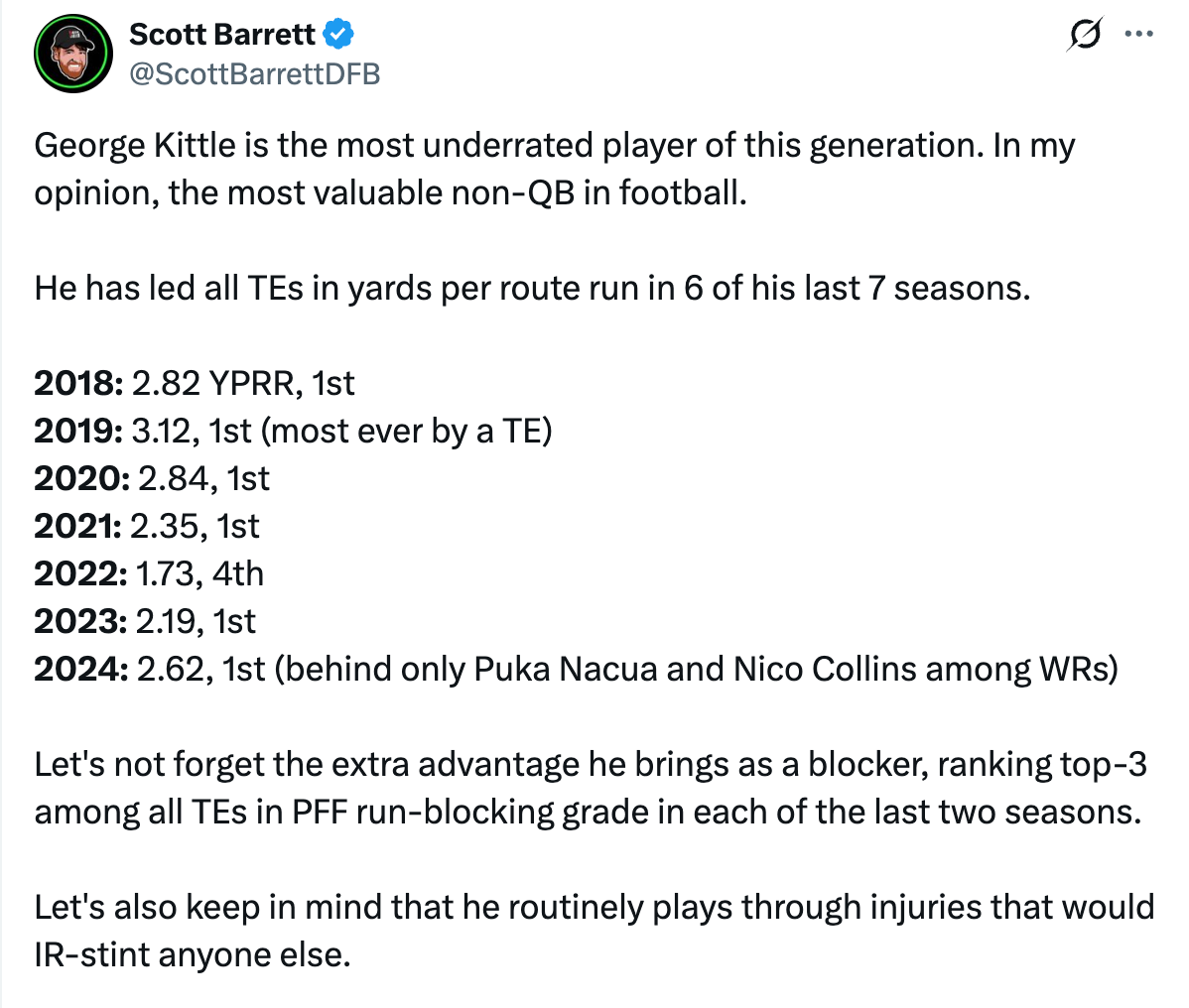
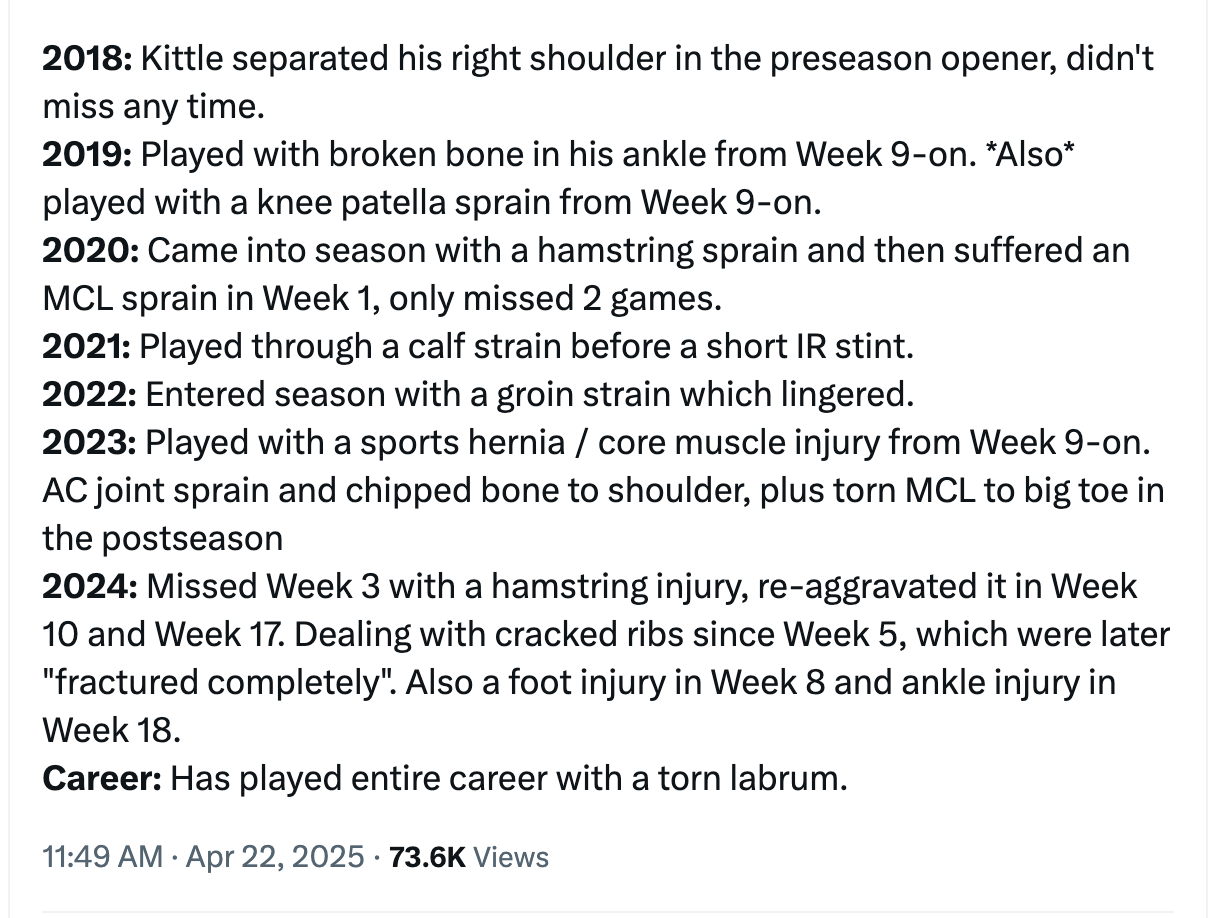
George Kittle is, in many ways, an offensive system fit into one man. He’s both the setup and the knockdown, an independent force that powers everything. The numbers bear this out as well.
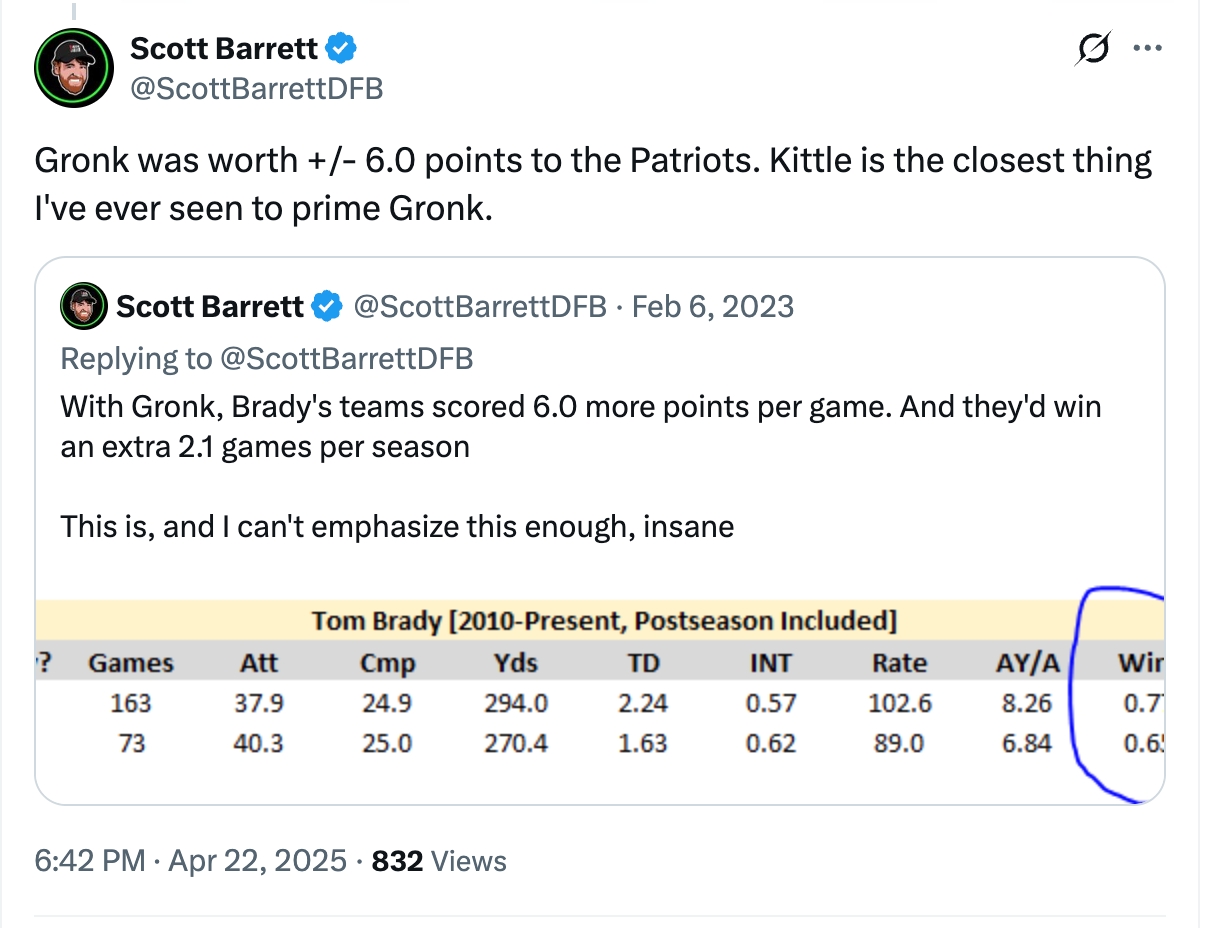
While he’s not fully Gronk, Kittle is not far behind, and this is the impact of one of these guys. The absence of Kittle is a one-shot to the vaunted Shanahan 49ers run game. Per Sumer Sports, over a sample of their available data (2022-2025), their run game breaks down as follows:
Kittle
Attempts: 1,494
Yards Per Carry: 4.76
Rushing Success Rate: 43.98%
EPA/Rush: 0.016
No Kittle
Attempts: 970
Yards Per Carry: 3.68
Rushing Success Rate: 26.80%
EPA/Rush: -0.066
That’s over a full yard lost per carry, a near-halving of success rate to a level that is genuinely atrocious, and beyond an inversion of overall efficiency. On-off splits are, by rule, statistically loud and often useless, but Kittle’s impact as a blocker is obvious on film and noticed in absentia. It’s no coincidence his midseason return yielded immediate improvement on SNF against the Falcons despite not touching the ball. It’s not just blocking in isolation that impacts the run game. The fact that he can play with multiple other pass-catchers and still be the scariest guy, while also being that blocker, creates run/pass conflict that defenses can’t bridge. The interplay therein too feeds the run game. The 49ers have usually had another TE who can block pretty well, between Ross Dwelley, Charlie Woerner, and now Luke Farrell, but they lose all of the receiving in making that replacement. Any decline in the 49ers’ run game dampens the entire system, which is based on run-pass conflict, dictating looks, and picking at defenses that are frozen into predictable structures by the need to honor the box. Just as all of Kittle’s attributes feed into each other, their absence does too in a system that is layered like a building. Kittle is the foundation of that building.
Despite all of that value, George Kittle ranks 125th in the entire NFL in APY on his contract at $19.1M per, which sits just between L’Jarius Sneed and Tyson Campbell. I think he’d be the most valuable non-QB regardless, but when you factor in the surplus relative to cost, it’s not a contest.
How He Does It
Let’s take a look, to start, at what George Kittle is athletically. He’s 6’4, 250, which is the size of Micah Parsons, and he runs a 4.52, which is faster than Cooper Kupp or Davante Adams. While that’s not impossible to find, it’s the combination of raw strength and out-the-gate acceleration that makes him highly unusual.
If you don’t feel like reading more, all you have to know about George Kittle is that the player in both clips is the same guy. If you do, we can get into more detail.
The Great Hybrid
Think, for starters, about how different an OL and a WR are. For perspective, let’s put it into defensive terms to elucidate how absurd players like Kittle are. There are plenty of DB/LB hybrid types like Jalen Pitre or Kyle Hamilton, but name one guy who plays both DB and as an every-down Defensive End. Name one. Just one, ever. Take as much time as you need. It’ll be a while. That’s essentially what Kittle is. He’s a detachable DE who can rush the edge, defend the run, and play man coverage at DB. The difference is that you don’t usually need the TE in pass protection (though he does that too), so it’s not the same dynamic as taking a body out of coverage on D. None of the theoretical costs of a DE/CB hybrid apply. The value is in the totality. Maybe you have a guy who can catch and another guy who can block, but in a game with 11 players a side, never more and never less, nothing exists in isolation. The downstream value of a guy like this is huge. That’s where the statistical impact of Gronk and Kittle derives from. A yard receiving for them is worth twice the value of a WR or a flex-only Tight End because they preserve your ability to do everything, give you a whole bonus pass-catcher with no cost. While a guy who is serviceable in-line gives you a ton of value as well, a guy who is a true WR/OL hybrid blows all of that out of the water. If you were to quantify their impact in receiving yards by multiplying them by two, imagine how Kittle would be viewed. That’s how you have to view him.
The Shanahan/Kittle System
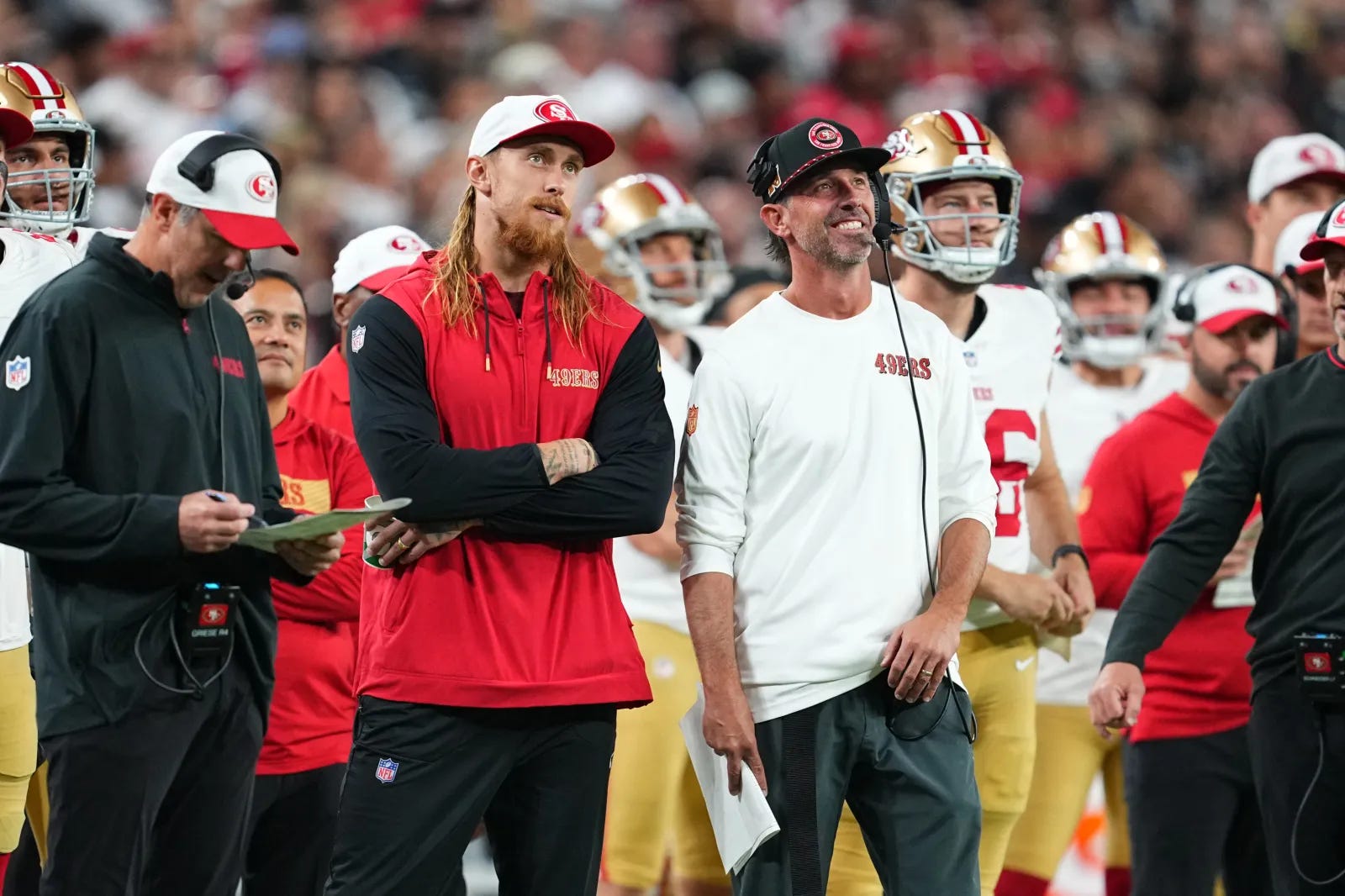
There’s no question that George Kittle is the defining piece of the Shanahan-49ers era. While Shanahan has proven with other franchises that he can build elite offenses without George Kittle, he has built the 49ers version of his offense in his image, especially in recent years. Describing Kyle Shanahan’s system takes many more words than this, and it has changed even throughout his 49ers tenure, but from a 10,000 foot view, it’s a positionless 2-back wide-zone based offense that uses its ability to run the ball at all times from any grouping to dictate defensive structures. When you can dictate structures, you can attack with specificity and intention, which grants you the ability to pick at sore spots on D and makes life for the QB much, much easier. Shanahan has been able to put up offense without much at QB, as we’ve seen with Jimmy Garoppolo and the very early version of Brock Purdy because of that dynamic. The conjunctive elements of overwhelming run and overwhelming pass is the key to Shanahan. No matter how the NFL has changed, his systems have always been built around the run game. That run game has changed in some ways, and how they’ve built around it has changed, but that broader view has never changed.
It’s not enough to run the ball from a weakened position to keep defenses honest while you’re decked out to pass the ball. Running into “light boxes” doesn’t do anything if your own box is just as light. You have to be built as if you are decked out to run it over and over AND to pass it with the same danger. Full pass game, full run game, all at once. For that, they need 3 guys who can handle a WR load in volume and route repertoire, 2 RB, and an elite in-line TE on the field at the same time. Well, that’s impossible right? You have 5 linemen, 1 QB, 2 WR, an HB, a TE, and then can choose between a 2nd TE, 3rd WR, or a FB right?
Well, yes, but Kittle occupies the role of elite in-line blocker and 3rd WR at the same time, killing two birds with one stone.
In general, there are two things that can supercharge an NFL run game from the perspective of the entire unit. Of course, you need foundationals like a capable OL, but these things are the key servebreakers you need to run the ball in a league this difficult:
1: The threat of the pass. If a team is committing resources to your pass game, they’re in structures that are much easier to run against. But you still need at least a passable blocker in-line at TE for those structures to be attackable.
2: An elite in-line TE. While a good or even passable in-line guy won’t prevent your run game from being good, an elite road grader gives you a ton more beef on the LOS and has downstream impacts by removing limits, freeing up other blockers, and creating a side with essentially a real extra lineman on it.
Kittle adds 100th percentile ability to both buckets. When they want to dial-up pass concepts that require 3 WR, he just goes out as that, because Jusczyck isn’t gonna do that at the F (which in 3 WR is a slot). Again, you generally need 3 WR types to shoulder the bulk of true, spread-out concepts and 2 outlet-type peripheral receivers who are kinda just there to be eligible and good enough to catch a checkdown or pop open on a designer play. The latter are usually the TE and RB, but they use the FB and RB because of Kittle. This also makes play-action, the famed backbone of the Shanahan system, lethal. Unless the D can answer with a DE/DB hybrid, which we’ve established does not exist, Kittle is always putting them behind serve. This all culminated for Shanahan with the 2023 Death Lineup.
Kittle wasn’t the only positionless monster on that unit. He was the most positionless, but he wasn’t the only hybrid. Deebo Samuel and Christian McCaffrey played both true RB and true WR, Kyle Jusczyck, as always, played both TE and true FB, and Kittle played both OL and WR as that 100th percentile everything TE. This was their final form, built in his image, built on his back. They were untouchable, though a lack of an elite QB made them situationally vulnerable when the run was not an option. Even in those situations they were generally good, but overall, this was one of the most unstoppable offenses of all time. Previously, Shanahan’s offenses were defined by big X receivers who could crush the 1v1s created by the run game with all manner of in, out, and vertical breaking routes on PA. In Houston, that was Andre Johnson, and in Atlanta that was Julio Jones. The offenses in SF are all about Kittle’s positionlessness and explosivity. We’ve talked about those abilities, but not as much about what goes into them.
Kittle The Receiver
Kittle’s defining characteristic is the jetpack burst and runaway train explosion he brings as both a route runner and runner after the catch.
In that, you see his primary use, which has always been to stretch the middle of the field and create huge plays. As an in-line element, there’s no way to cover this because any defender covering would need to have an assignment in the run game. In man that’ll be a S, in zones he’ll stretch the area covered by the ILBs. You have to pay special attention to a guy like this in coverage but….you can’t.
That makes him easy to lose in play action. Despite the whole “extra OL” thing creating easy openings for him that, given his talent, become devastating, it’s not like he needs them to create.
Kittle is a nightmare cover for CBs too, even man to man. Especially man to man! The size makes him impossible to impede and the speed/change of direction makes him difficult to close on out of the break.
As any good TE must be, he’s a chain-mover between the hashes too. Despite the speed and mass, there’s a suddenness, maneuverability, nimbleness, and deceleration that makes him a tough a cover in the short area as the long.
Kittle the Lineman
A wide zone system like Shanahan’s requires you be able to run the ball to either side at any time. These sides are separated into the “open side,” which has no TE and the OT is the last guy on the line, and the “closed side,” which has the Y. This applies to all run concepts where the formation isn’t “balanced” with a TE attached to either side. While wide zone blocking on the closed side has less of a physical demand than downhill schemes where you have to win a sumo match, it’s no less important, and sometimes it’s just as physical. When you’re on the frontside of wide zone, you cannot have your movement stopped under any circumstances. If you get stopped or even worse, knocked back, it stops the entire line and creates a pileup that will force the RB to cut back too soon into traffic.
Kittle’s athleticism is great for getting him across face to pin guys inside, but the strength allows him to move guys when they try to set a physical edge and nail him down. The consistently clean perimeter has been a big luxury over the years for Shanahan. If you can hit the edge in wide zone, whether just outside the TE or just inside him, so much of the OL can get away with basically anything and the backside doesn’t have to factor in at all.
If you don’t hit it there, he’s at least allowing the RB to press the edge, take his time, work his progression, and split the defense down the middle.
Whether basing, pinning, or driving the end on downhill schemes like duo, pin/pull, counter, power, or inside zone, they always have an edge there too. They’ll run all of these, it’s as good a grab-bag run game as you’ll ever see.
Depending on how they move the DL, teams can use 3-4 fronts to exploit mismatches against TEs. If they bump one of the DEs over, they can put him head-up on the TE and since in a 3-4, those are more DT body types than EDGE body types, it’s usually a big problem due to the size difference. Not in San Francisco.
Oh and he can 1v1 true EDGE rushers in true pass sets too. Most TEs, even good run blockers, do not have the athleticism, technique, and anchor strength to hold up. While this isn’t often asked it’s more valuable than you could ever imagine in blitz pickup, because it gives you far more flexibility to slide the entire OL. All because they have an extra to spare.
Dear Writers,
I will finish with a plea to those of you in the football space who vote on things. Do right by the game of football. Don’t do right by the game we imagine is played on the stat sheet, don’t do right by the votes and OPINIONS of the past (which is all an All-Pro vote ultimately is); do right by the actual game. I am here to tell you that, whether you thought so previously or not, George Kittle is among the pantheon of the greatest players this game has ever seen. Kittle has been first-team All-Pro just twice, deservedly in 2019 and 2023. He should have also been first-team in 2024 and 2018. In fact, he should have won Offensive Player of the Year in 2018, which went unfairly to Patrick Mahomes despite the entire modern purpose of the award’s existence when he set the record (at the time) for receiving yards for a TE in a single season. Setting such a record while blocking at the level he does makes it a runner-up to Gronk’s 2011 for the greatest seasons the position has ever seen. First-team AP honors went to Travis Kelce, who produced in the pass game at an equal level to Kittle despite an offense with GROSSLY more passing volume/emphasis, while being an active negative to the Chiefs’ nonexistent run game. Kittle’s legacy has been harmed unfairly already by a misunderstanding of this position, and that should be corrected come HOF time. Even if he were to retire right now, there should be zero doubt about his destiny in Canton. Luke Keuchly played just 8 seasons, Calvin Johnson 9, and Aaron Donald 10. If you don’t view George Kittle as one of those players, that’s on you, and I hope I can convince you to reconsider.
Greeting from Mobile Max! Watching my guy Stanford TE Sam Roush ( who you did a nice piece on about this time last year) looking really good at the Sr.Bowl practice sessions. We talked about him during the season when I was surprised you didn’t initially mention him early on this season. I think he’s gonna end up making some NFL team very happy!