

Indiana's Silent MVP
Fernando Mendoza and the passing game get all the headlines, but the trenches are the difference between Indiana a year ago and the Indiana that runs college football. Their TE is the driver.

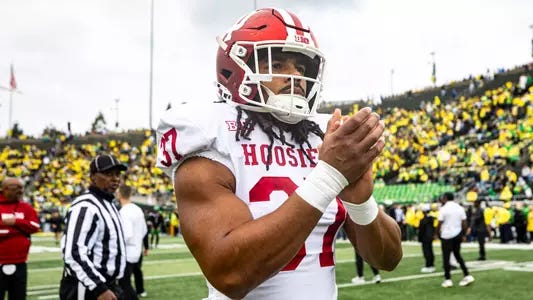
Any team with a Heisman-winning QB and multiple draft picks at WR is going to be branded as a passing team. That’s not inaccurate or anything, Indiana throws the ball at a very high level, but a lot of teams with good skill have gotten run out of the higher levels of competition. Indiana is a midwestern football team, and their lines of scrimmage are as physical as any in the country. As we saw Saturday against Alabama, Indiana, despite being in 3 WR almost all of the time, will run the football over and over and over and over if you allow them. It’s the basis of their offense despite where the accolades lie, and there is one man entirely irreplaceable in that operation.
Diamond in the Rough
Tight End Riley Nowakowski, an unheralded transfer from Wisconsin, is not the kind of TE that generates headlines, but Indiana built their run game around him. Nowakowski’s path here is a strange one, because physically, he was built to play Fullback, not TE. He’s only 6’1, but fits a stout 250 pounds into that compact frame. Players built like him has clear and obvious roles in offenses for decades, but when Phil Longo got to Wisconsin and brought the air raid with him, the FB position went extinct Madison. Now, that is a crime against football, Wisconsin ought to have Fullbacks, but Nowakowski had to learn the only other position he could play. Height be damned, he’s been terrific, and Curt Cignetti saw that vision. The fact of the matter is that, because of increased exposure to single blocks, a relative lack of size, and a much bigger drop off in ability between good and bad, the TE is the most singularly impactful part of a run blocking unit. A backup OL may be bad, but he’ll still be 300 or so pounds and physically able to stand up strength wise to his opponent. To be dominant, a TE has to overcome a size disadvantage, usually topping out at 250-260 as their opponents can push 270-280 at DE. Additionally, bad TEs are not even viable physically at the point of attack. It’s not just that they’re bad like a bad OL, they’re not viable. Unfortunately for the OC that doesn’t make them less important, and if a TE has difficult blocking demands, he alone can wreck your run game if he can’t handle them. If he can’t handle them, there’s a ton you can’t do. So how does Indiana take advantage of what they have?
Based and Blockpilled
Indiana is not very fancy, they want to run inside zone downhill. They want two double teams on the interior, they want to push you, and they want to punch straight forward. That leaves the TE 1v1 on the DE by definition. With 4 OL committed to the 2 IDL and 2 ILBs and the 5th on the other DE, you need a 6th line guy. The problem is that these blocks are incredibly difficult. You’re 1v1 with a DL and you don’t have any help. A lot of times, teams will try to split the TE across the formation to give them a running start and make this block easier, but you can start setting fronts based on the TE’s alignment because you know which side the run will start to. Nowakowski is a master of the base block, which is one of the most difficult a TE has to make. When the DE is outside of you and the run is going inside, you won’t be able to get ouside him and wash him down for a bounce lane. Your job though is still to create a bounce lane. As a result, you have to prop that guy out and create a new perimeter inside of you for the RB to penetrate if the interior is clogged. That’s what the base block is designed for. Above is a good example. What makes this so difficult is that you have to anchor and stop their momentum. You don’t get to just usher them on their path or get in the way, you have to stall and move them out against their will. Check out the various stages below.
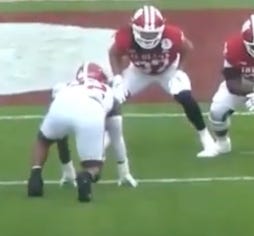
First you have the alignments. Base blocks can be easy if the DE is standing up or in a wide alignment and rushing upfield. That is not the case here, he is trying to strike, cave, and control Nowakowski. He’s gotta stop that. This DE is LT Overton, and he is no modern woke speed rushing hybrid. He stands 6’5 and weights 278 pounds, he is built like a proper 90s 4-3 DE. He also has the leverage advantage here of being in a 4-point stance on the ground while Nowakowski is standing. The X WR is on the ball so he must be off, which means he must be standing like this.
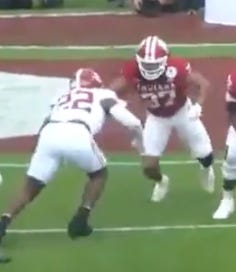
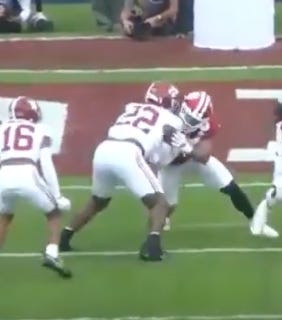
Next you have the initial strike. Overton doesn’t know if he’s rushing the passer or playing the run, so he can’t just dive into Nowakowski’s midsection and cheat. That said, he still has a lower starting point. Nowakowski is a master of leverage, and this is where his height HELPS him (short king W) as a blocking TE. He sinks the hips, gets way down, and gets UNDER Overton’s shoulders. Look how bent he gets in the midsection. His hands and head are placed well, with the facemask in the shoulder and the hands up under the ribs. I’d rather that inside hand be in the armpit but let’s be honest, you can teach that as a landmark but it’s chaos in there, it’ll happen sometimes, it won’t happen others.
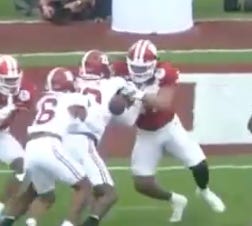
From that underneath leverage, he can forklift with control. When you stand a guy up like this, he is no longer controlling you, you are controlling him, and at that point, you can move him where you need to move him for the run to work.
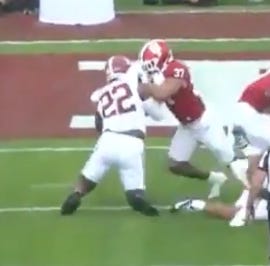
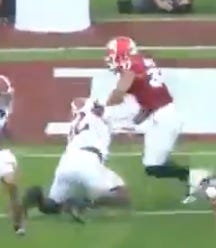
Nowakowski lifts, extends, and turns him out with enough power to bring him to his knees and finish him.
When the defender wants to stay outside and handfight, he can’t go through, you just have to keep square feet and almost defend him you’re boxing out for a rebound, only reversed.
Pin and Seal
Sometimes, like on perimeter gap scheme plays where pullers lead outside, you have to wash your guy inside no matter what. In those situations, you have to do the same thing in general, just reversed. You have to make sure you capture their playside shoulder, which means getting between them and the ball, and shove them down inside to create a clean lane for the pullers and RB. Once again, you must anchor and hold the line if your guy wants to go through you. If he wants to wash himself down inside out of the play, take him there. Because of their front 6, Indiana can pound you over and over if you try to do anything about their QB and WRs.
Pass Pro
Unlike most guys, even those who are good run blockers, pass pro 1v1 on an end is all good for Nowakowski. Whether protecting boots, picking up pressures, or taking the backside of a slide, he is a big part of why Indiana’s pass game is so hard to speed up. The Hoosiers were blitzed a ton by Alabama in the Rose Bowl, and a lot of them looked like the above with a squeaky clean QB and an opening downfield.
Receiving???
The short answer is that they don’t need him to do much, they have 3 WRs who are stars on the field all the time to handle all the real route running, but he’s got a little bit of juice and slipperiness after the catch that deserves mention. As a screen target and checkdown outlet, he’s a big positive, and that’s all they really need from him. Indiana is on the precipice of history, and they couldn’t do it without 37.